
Fix the problem

My engineer son has a mantra: “Fix the problem.” As mantras go, it’s a pretty good one. Simple, memorable, intuitive, and to the point. The mantra refers to our tendency to go about addressing issues, problems, or stuck situations by doing a lot of things none of which will actually “fix the problem.” It’s an amazing phenomenon, all the more so for how common it is. Since my son’s brain is wired in the logical-pragmatic mode of the engineer he often is amused at the non-logical way people try to solve problems. Continue reading
Posted in curriculum, Sunday school | 2 Comments

Cop-at-the-door (contest)

When we were young my siblings and I would often receive a warning from our mom whenever we ventured from home. With a somber voice and a straight face (but not without a twinkle in her eye) she would admonish us, “Don’t let me see your picture in the paper!” It was a stay against the angst of parents worldwide that their children would go astray in the worst way—but, worse still, that their veering from the path of righteousness and light would be of a public nature thereby causing the anguish of embarrassment for the parents. Offspring are prone to be inconsiderate in that way, at times, it is well known—especially if they are adolescents. Continue reading

Posted in children, personal growth | 3 Comments

Those voices from the past

Ever get one of those phone calls that start out, “Are you ___________? You may not remember me, but . . .” I’ve gotten several of those over the years. Most of the time those voices from the past lead to a delightful re-connection with past acquaintances: long lost friends, former colleagues and students, old college roommates, maybe even a former girl- or boyfriend. This evening I got one of those calls, but it was one that left me with mixed feelings. Continue reading

Posted in Prayer | 1 Comment

How to make silly putty (a ministry skill)

Despite the serious and lofty education most of us clergy receive in seminary (theology, Greek, Hebrew, Latin, hermeneutics, philosophy, etc.) ministry has, decidedly, a pragmatic skills component to it. As one person put it, you have to “know stuff” (and she wasn’t referring to “book learnin’”). Pity the congregational minister who doesn’t develop skills to grease the rails of ministry in the real world. To quote Napoleon Dynamite, “You know, like nunchuck skills, bowhunting skills, computer hacking skills… Girls only want boyfriends who have great skills.” Continue reading

Posted in children, games, humor, movies and films | Comments Off on How to make silly putty (a ministry skill)

So you want to start a blog?

I am thrilled to be a part of this blog team! I started my own blog a few years ago (which needs much TLC) and have been an advocate for blogging since. Along my journey, I have inspired individuals and groups to create and maintain a blog and have tried to give good advice on putting up content. Creating a blog is easy with free blog hosts like WordPress and I would encourage you to follow the link to begin your own journey. Continue reading

Posted in technology and education | Comments Off on So you want to start a blog?

Myths about Opossums, Goats, and Holistic Learning

The following is from the book Myths: Fact and Fiction about Teaching and Learning by Israel Galindo. How well do you know fact from fiction?

MYTH: Opossums “play dead” when they are threatened or endangered. Continue reading

Posted in Christian Education, Sunday school, teaching | Comments Off on Myths about Opossums, Goats, and Holistic Learning

Myths about Trees, Eve, DNA, and Interpretation

The following is from the book Myths: Fact and Fiction about Teaching and Learning by Israel Galindo. How well do you know fact from fiction?

MYTH: Trees are critical to earth’s survival because they provide most of the earth’s oxygen through photosynthesis. Continue reading

Posted in bible | Comments Off on Myths about Trees, Eve, DNA, and Interpretation

Silence for Youth

I’m preparing a session for an upcoming youth retreat on the topic of “Silence and Solitude as Spiritual Disciplines.” It has caused me to think about the lack of silence in our lives in the US.

My parents owned a small cabin near Warsaw, Virginia on a tributary into the Rappahannock river when I was growing up. They never had a telephone installed there (this was way before cell phones) and the small TV could only pick up two stations on a good day. The place was amazingly quiet, and it gave me time to fish, swim, and walk in the midst of silence. Most of our teens today have constant noise, or the potential of noise invading their lives all the time. Cell phones, IPods, computers, cable TV, radio (how do you like yours—AM, FM, XM, Sirius, HD…?), and a host of other sounds invade the lives of our teens every day. Continue reading

Posted in discipleship | 4 Comments

Leadership in Ministry Workshops summer newsletter

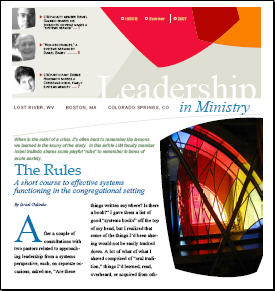
The current issue of the Leadership in Ministry Workshops newsletter (Summer 2007) is now available. Download the newsletter (.pdf, 10 pages) here: limsummer07.pdf. (This is an “interactive” document, so look for tags to websites and features).*

limsummer.jpg

ISSUE CONTENTS:

  • The Rules, Israel Galindo
  • Non-negotiables, Daniel Bagby
  • What is a Systems Sermon? Israel Galindo
  • Leading from the Right Side of the Brain, Israel Galindo
  • Book review: A Failure of Nerve
  • LIM Facutly News
  • A Holiday Roll Nodal Event, Debbie Highsmith
  • Conceptual Similarities, Michael Gillen
  • A Message from the LIM Coordinator, Lawrence Matthews

*Be sure to download the document (Right-click and “Save as….”) to your computer. Some computer settings may block your ability to access the attached resources and documents on the newsletter if you try to read it from the server. To access the website links be sure you are on-line.

Posted in bowen family systems theory, leadership, second chair, sermons | 1 Comment

Avoiding “Fuzzy Thinking”

One of the things I strive for in my classes is to help students move from “fuzzy thinking” about matters of faith to the capacity to engage in “critical thinking.” Fuzzy thinking takes different forms, including, “devotional,” “rhetorical,” “metaphorical,” and “magical” thinking. Those forms of thinking have their place. It’s not an issue of them being inferior to a more rigorous way of thinking. But a mature faith is a critical faith in that it has the capacity to reflect on its own experience, critically assess and think about phenomenon, and move from naiveté to mature thinking. As St. Paul said, “When I was a child I . . . thought like a child, reasoned like a child. When I became an adult I put childish ways behind me.” Continue reading

Posted in Christian Education, personal growth, philosophy | Comments Off on Avoiding “Fuzzy Thinking”