

From the Wabash Center’s blog for theological school deans. Read the article here.
From the Wabash Center’s blog for theological school deans. Read the article here.
After a formal group conversation about educational theory at a recent event a theology professor and I took our break outside the conference building. As we sat on rocking chairs looking over the vista the professor apologetically shared his frustration at hearing people talk about the “creative” methods they used in their teaching. His frustration was, in part, his inability to see how some of those creative methods applied to his field of discipline. If there is a stinging assessment of one’s teaching that hurts most, it may be the comment, s/he’s not a very creative teacher.” So I appreciated the source of his angst. Continue reading
Personality Type and Religious Leadership reports the result of research done by Roy M. Oswald and Otto Kroeger at the former Alban Institute. Around 1983 Oswald began using the Myers-Briggs Type Indicator (MBTI) to help church professionals across denominations understand better themselves, their ministries and the people they serve. The first chapter of the book sets the stage for understanding why understanding type is important. The chapter includes a Rashomon-type story in which four ministers in a car on the way home from a three day seminar, share different reactions and different understandings of their ministries. The story makes the point that understanding our own personality type, as well as the types of those we work with, is important to our effectiveness as ministers.
Read more at the Along the Journey blog site:
http://columbiaconnections.org/2014/12/01/for-the-bookshelf-personality-type-and-religious-leadership/
Effective teaching in the online environment calls for following sound pedagogy, often, the same as those practiced in the classroom. After all, in a real sense learning is learning, regardless of where it happens. Whether you are teaching a dedicated online course, using a hybrid format, or using a LMS course site to support the classroom learning experience, it’s helpful to follow learner-focused instructional practices when setting up your online course site. One such practice is induction–and, you can never overdo it.
When I was in parish ministry our staff met weekly to do worship planning. In addition to reviewing text, sermon topic, music, hymns, and other components of the worship service we would always ask and decide on the question, “how will we enter the room?” That is, how and when would the worship leaders (choir, pastoral staff, etc.) enter the worship space so as to lead the congregation into the worship experience. We wanted to “set” the tone, affect, and focus of the worship experience from the beginning to create expectancy, and help the congregants know how and what to pay attention to. Continue reading
A review of Barry Callen’s book, Authentic Spirituality, at the Along the Journey blogsite. “… beyond dead orthodoxy to the authentic Christian faith of the heart…”
Using a hybrid format for a course often means increasing the use of the online discussion forum as a primary pedagogy. This can enhance the learning experience, deepen comprehension, and offer a means for more immediate application of knowledge. It is sometimes difficult, however, to hone the skill of asking the best KIND of questions for the online environment. Too often we tend to revert to rudimentary “comprehension” questions that may be necessary in a classroom concepts-acquisition pedagogy, but not very optimal in the online environment. As always, a helpful question to ask when designing every component of your course is: “What pedagogical function does this serve?”
Here is a great short piece by Stephanie Maher Palenque, MA and Meredith DeCosta on “The Art and Science of Successful Online Discussions.” Their major points can make a great checklist for reviewing your online discussion forum questions. Do your questions merely solicit basic comprehension, or do they move the students to deeper learning?
I was engaged in a conversation about on-line learning recently, with someone who has never taken an online course nor taught in that context. I must confess that some of those conversations were interesting at one time. But after teaching on-line courses for fourteen years now I find myself weary of addressing the same rudimentary questions from the uninformed. My impatience usually is with those who are quick to dismiss online learning without having done the responsible work of investigating it. My interest in talking further wanes when it becomes evident that they have thought as little about the pedagogy of the classroom courses they teach. Continue reading
Post on understanding and interpreting the impact of entering students.
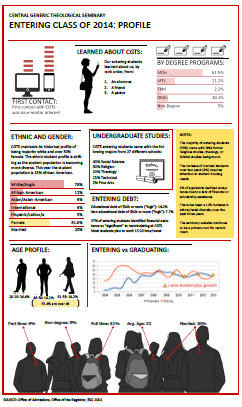
New post at the Wabash Center’s blog for theological school deans: Does your curriculum use high-impact pedagogy?

The online environment is a visual medium. Whether you are teaching a dedicated online course, using a hybrid format, or using your online course site (Moodle or Blackboard) as a resource and enrichment component of your classroom course, “style” and design matters. Make your course site beautiful.
One way to integrate aesthetic components into your Moodle course site is to incorporate art. Art can serve several pedagogical functions:
When using graphics and design elements be sure there is a specific pedagogical or design FUNCTION the image will provide for the student learning experience. Posting images of puppies or fluffy kittens adds no pedagogical value and merely confuses your students (unless you’re teaching about puppies and kittens, of course).
Here’s a great resource site for art and historical images: the Smarthistory from the Khan Academy is a leading open educational resource for art history. Their high-quality art history content is made freely available to educators. The site offers more than 600 videos and hundreds of articles in addition to hundreds of images.
The site itself is a great example of elegant visual design for an online learning experience.
Israel Galindo is Associate Dean for Lifelong Learning at the Columbia Theological Seminary. Formerly, he was Dean at the Baptist Theological Seminary at Richmond. He is the author of the bestseller, The Hidden Lives of Congregations (Alban), Perspectives on Congregational Leadership (Educational Consultants), and A Family Genogram Workbook (Educational Consultants), with Elaine Boomer and Don Reagan.
Galindo contributes to the Wabash Center’s blog for theological school deans